I generally don't care much about Malaysia's recent claims over cultural products (i.e. batik, angklung, the song 'Rasa Sayange') native to peoples who now live in Indonesian territories. That is, as long as such products are left in the public domain.
However, this time some Malaysian academics have gone too far. As Kompas reported, they are now roaming over Indonesian villages, 'hunting' for classic Malay manuscripts, and place them on a site which people have to pay to use.
Really, I don't care if they claim it as part of their culture. But putting proprietary rights to something that they did not invent? Please...
Showing posts with label Humanity. Show all posts
Showing posts with label Humanity. Show all posts
Thursday, December 13, 2007


Thursday, October 25, 2007
Is anti-urban-migration growing?
Jakarta's hate for new incoming migrants from rural areas seems to be spreading.
Now the government of Cilegon, an industrial city in Banten, expects new migrants to provide cash collateral to the municipality. Meanwhile, in Serang, people who don't have local ID cards are facing a fine of Rp 50 million (~USD 5,000) or six months of jail.
Can't the national government (i.e. the ministry of law and human rights) do something about this?
Now the government of Cilegon, an industrial city in Banten, expects new migrants to provide cash collateral to the municipality. Meanwhile, in Serang, people who don't have local ID cards are facing a fine of Rp 50 million (~USD 5,000) or six months of jail.
Can't the national government (i.e. the ministry of law and human rights) do something about this?
Monday, October 22, 2007
Stop stopping them from coming to Jakarta!
Every year after the Idul Fitri holidays, the Jakarta government conducts Operasi Yustisi. That's the hunt down of "illegal" migrants coming into Jakarta from Indonesia's rural areas. This year is no different. The sad legacy, unfortunately, is kept by Jakarta's new Governor, Fauzi Bowo.
Mr. Bowo cites Jakarta Bylaw no. 4/2004 as the legal basis of this ironically named operation. He said, "Jakarta is dense enough already. Those who don't have a job and place to live will only burden the city." Illegal migrants (those who are caught without Jakarta ID card) will be fined Rp 5 million (~USD 500) or jailed for 3 months.
Of course, the policy is useless, as Supriatna argues. The poor (which is the reason they came to Jakarta in the first place) don't have that kind of money. And if they are "returned" to their original village, they are sure to come back as there is very few economic opportunity in rural areas. As bad the condition they face in the city, it is almost always much better than if they stayed back. That's called hope. And surely the hope is quite high, at least as high as the demand for low-skilled labor in big cities.
So it makes all sense to let the rural poor come into cities. So why oppose? Is it because we get sore eyes from seeing poor people in the streets? Is it because we don't want Jakarta to be more crowded and messy? Let's not forget: Most of us in Jakarta (at least our parents/ancestors) were once migrants, maybe as poor and as "kampungan" as the villagers are now. Who are we to now deny other people the opportunity that we've received in the past?
PS: This is what I wrote about this issue last year. Do I have to do this every year? Bring it on!
Mr. Bowo cites Jakarta Bylaw no. 4/2004 as the legal basis of this ironically named operation. He said, "Jakarta is dense enough already. Those who don't have a job and place to live will only burden the city." Illegal migrants (those who are caught without Jakarta ID card) will be fined Rp 5 million (~USD 500) or jailed for 3 months.
Of course, the policy is useless, as Supriatna argues. The poor (which is the reason they came to Jakarta in the first place) don't have that kind of money. And if they are "returned" to their original village, they are sure to come back as there is very few economic opportunity in rural areas. As bad the condition they face in the city, it is almost always much better than if they stayed back. That's called hope. And surely the hope is quite high, at least as high as the demand for low-skilled labor in big cities.
So it makes all sense to let the rural poor come into cities. So why oppose? Is it because we get sore eyes from seeing poor people in the streets? Is it because we don't want Jakarta to be more crowded and messy? Let's not forget: Most of us in Jakarta (at least our parents/ancestors) were once migrants, maybe as poor and as "kampungan" as the villagers are now. Who are we to now deny other people the opportunity that we've received in the past?
PS: This is what I wrote about this issue last year. Do I have to do this every year? Bring it on!
Thursday, October 11, 2007
Pedestrians as Anarchy

My friend and I talked at length the other day on anarchy. Initially were talking about squatters, and then he said, "You can't do whatever you want. That's chaos, that's anarchy!" Putting the discussion on squatting aside, I said anarchy does not necessarily mean chaos.
In case you haven't noticed, there is a lot of (created?) misunderstanding of big words here, just like communism is misunderstood as atheism. After arguing what anarchy really means (see some links on the right), I realized that I should have just quoted what James Surowiecki wrote about William Whyte in The Wisdom of Crowds. That should be easier. An example of simple anarchy in action, no chaos included.
No one has ever paid more attention to the streets and sidewalks of New York City than William H. Whyte... Whyte's work, which was eventually published in his book City, was full of fascinating ideas about architecture, urban design, and the importance to a city of keeping street life vibrant. It was also a paean to the urban pedestrian.
"The pedestrian is a social being," White wrote. "He is also a transportation unit, and a marvelously complex and efficient one." Pedestrians, Whyte showed, were able, even on crowded sidewalks, to move surprisingly fast without colliding with their neighbors. In fact, they were often at best when the crowds were at their biggest...
New Yorkers mastered arts like "the simple pass," which involved slowing ever so slightly in order to avoid a collision with an oncoming pedestrian. They platooned at crosswalks as a protection against traffic. In general, Whyte wrote, "They walk fast and they walk adroitly. They give and they take, at once aggressive and accommodating. With the subtlest of motions they signal their intentions to one another." The result was that "At eye level, the scene comes alive with movement and color - people walking quickly, walking slowly, skipping up steps, weaving in and out in crossing patterns, accelerating and retarding to match the moves of others. There is a beauty that is beguiling to watch."
What Whyte saw - and made us see - was the beauty of a well-coordinated crowd...
Anarchy is simple the absence of a ruler. And as the streets of New York shows, the absence of a ruler does not have to mean chaos. People - in many cases - can coordinate themselves beautifully.
PS: The picture above, is actually not of New York's pedestrians, but of Tokyo's. It's from UNFPA site.
Saturday, October 06, 2007
Jakarta's blunt declaration against the poor
 A new Jakarta bylaw on 'public order' will fine you up to Rp 20 million (~$ 2,000) if you give to beggars, street vendors, street performers, etc. Also, motorcycle taxis and bajajs are illegal, and bicycles and transvestites are put at a disadvantage. The reason for the Perda no.8/2007 is to 'safeguard Jakarta's image as the nation's capital'.
What crap.
The Poor People's Alliance has produced an article-by-article critique on the bylaw. UPC has issued a press release to reject it.
Fortunately, the Ministry of Home Affairs has agreed to review the bylaw, to check whether it violates public interest and any other law above it. And so has the Ministry of Law and Human Rights. We'll see what happens.
Picture from supermilan.wordpress.com
Friday, May 25, 2007
Modern woman vs outdated mentality

Let's talk about art for a change.
The EKI Dance Company is now performing their latest musical, Miss Kadaluwarsa, in Jakarta. I went to their show last night, and loved it very much. First off, the stage performance was awesome. A big salute to the cast and dancers, the musicians, and the lighting, sound and stage technicians. And of course, to the people behind the stage who made this all happen.
What's no less interesting is that this musical brings up an issue faced by probably many women in culturally transitioning countries like Indonesia: how should a single, successful career woman view the notion of marriage, and the role of a man/husband in her life? Miss Kadaluwarsa [kadaluwarsa means expired] points out, in a hilariously entertaining way, that a "modern" woman could still be trapped in an "outdated" mentality that keeps her unhappy and tied to unnecessary binds.
Miss Kadaluwarsa is playing in Gedung Kesenian Jakarta, May 23-27.
Here's the info on schedule, prices, and ticket boxes.
Update: Here are some photos from the show:


Monday, May 21, 2007
"The future is female"
British Telecom's futurologist predicts that the future will be about "the care economy." After the industrial age and the information age, the world economy will capitalize on what can not be automated or outsourced that easily: care. And who are "best suited" for this shift? Right. Women.
So I'd imagine the response from women is: "so what?"
Any thoughts?
Machines will be able to displace people from many of today's information economy jobs, just as they already have in agriculture and manufacturing, Mr Pearson predicts... "More recently intellectual jobs have been done by software."A big question remains:
Consultants, male or female, are easier to automate than nurses. A consultant is tantamount to "an expert system linked to a complicated brain", he says. But nurses' skills are all about being human, by listening and making patients feel better.
"Softer interpersonal skills that cannot be replaced by a system will be better valued than the more rigid skills," speculates Cheryl Clemons, a programme manager for Broadband East Sussex.
So if women have an easier time because their skills are more valued, does it mean they will also benefit financially? Not necessarily, Mr Pearson warns.I am thus reminded of school teachers. In the 'olden days,' school teachers were mostly men, and they are highly respected and the pay is not bad. Then one day, teaching jobs were shifted to women, and gradually salary level & social perception of teachers become less and less interesting.
So I'd imagine the response from women is: "so what?"
Any thoughts?
Wednesday, May 09, 2007
On happiness as public policy
I knew happiness is hot. But I didn't know that it's now on some countries' policy agenda (economists, here's a new challenge for you... or is this not related to economics?). Newsweek gives a report:
Personally, I like how happiness is portrayed in the recent Will Smith movie The Pursuit of Happyness. I love how Smith pointed out how Jefferson put in life and liberty as basic rights of U.S. citizens, but not happiness in itself. You don't have a right to be happy, but you have a right to pursue it. Maybe because Jefferson knew from then on that happiness means differently for different people.
And I also like how policy makers are getting wiser by considering happiness, as opposed to simply wealth, as a nation's goal.
Happiness is everywhere—on the best-seller lists, in the minds of policymakers, and front and center for economists—yet it remains elusive. The golden rule of economics has always been that well-being is a simple function of income. That's why nations and people alike strive for higher incomes—money gives us choice and a measure of freedom. But a growing body of studies show that wealth alone isn't necessarily what makes us happy. After a certain income cap, we simply don't get any happier.But really, can happiness be measured/figured out scientifically? The New York Times recently wrote a long piece on what is happy (Happiness 101). Whole classes on some elite universities are being conducted on happiness, or to train people to be happy(er). One class gave a "distinction between feeling good, which according to positive psychologists only creates a hunger for more pleasure — they call this syndrome the hedonic treadmill — and doing good, which can lead to lasting happiness."
Now policymakers are racing to figure out what makes people happy, and just how they should deliver it. Countries as diverse as Bhutan, Australia, China, Thailand and the U.K. are coming up with "happiness indexes," to be used alongside GDP as a guide to society's progress. In Britain ... the "politics of happiness" will likely figure prominently in next year's elections.
Personally, I like how happiness is portrayed in the recent Will Smith movie The Pursuit of Happyness. I love how Smith pointed out how Jefferson put in life and liberty as basic rights of U.S. citizens, but not happiness in itself. You don't have a right to be happy, but you have a right to pursue it. Maybe because Jefferson knew from then on that happiness means differently for different people.
And I also like how policy makers are getting wiser by considering happiness, as opposed to simply wealth, as a nation's goal.

Wednesday, April 11, 2007
Murray and Homelessness
UCLA tonight is featuring a lecture by Malcolm Gladwell, author of that really cool book The Tipping Point. Gladwell will talk about a specific issue that he wrote about a year ago in the New Yorker: "Million-Dollar Murray: Why problems like homelessness may be easier to solve than to manage."
The basic lesson behind "Murray" is similar to that behind "the law of the few" in The Tipping Point: pay attention to the few people who really make a difference. Why?
Gladwell suggested that we (meaning Americans) should just solve the homelessness problem, rather than keep trying to manage it.
The basic lesson behind "Murray" is similar to that behind "the law of the few" in The Tipping Point: pay attention to the few people who really make a difference. Why?
In the nineteen-eighties, when homelessness first surfaced as a national issue, the assumption was that the problem fit a normal distribution: that the vast majority of the homeless were in the same state of semi-permanent distress. It was an assumption that bred despair: if there were so many homeless, with so many problems, what could be done to help them?Then, Dennis Culhane discovered something that "profoundly changed the way homelessness is understood":
Homelessness doesn't have a normal distribution, it turned out. It has a power-law distribution. "We found that eighty per cent of the homeless were in and out really quickly," he said. "In Philadelphia, the most common length of time that someone is homeless is one day. And the second most common length is two days. And they never come back... The next ten per cent were what Culhane calls episodic users. They would come for three weeks at a time, and return periodically, particularly in the winter... It was the last ten per cent—the group at the farthest edge of the curve—that interested Culhane the most. They were the chronically homeless, who lived in the shelters, sometimes for years at a time. They were older. Many were mentally ill or physically disabled, and when we think about homelessness as a social problem—the people sleeping on the sidewalk, aggressively panhandling, lying drunk in doorways, huddled on subway grates and under bridges—it's this group that we have in mind.This last ten per cent includes Murray Barr, a chronic homeless from Reno, Nevada, who - although a nice person - had severe drinking problem that that costed the state one million dollars in "all his hospital bills for the ten years that he had been on the streets—as well as substance-abuse-treatment costs, doctors' fees, and other expenses..."
Gladwell suggested that we (meaning Americans) should just solve the homelessness problem, rather than keep trying to manage it.
because when a problem is that concentrated you can wrap your arms around it and think about solving it.A small portion of society is bound to need help/support from others, anyway. If we could just identify who they are, and not just lump them all together in our self-made categories, we may actually be able to solve the most important part of the problem (if not the whole problem).
Monday, October 30, 2006
Complexity as humanity's essence
 Idul Fitri celebrations just passed. They say the holy days were observed to celebrate human's return to its "essence." But what is humanity's essence?
For me, it's complexity. There is no single way to dissect humanity, as humans are both rational and emotional, individual and social, physical and spiritual, "good" and "bad."
Two weeks ago my cousin passed away. She was just 16. Her mom told this story:
She laid in the hospital bed. Signs of life were fading away. But everytime we cried, her heartbeat regained. It's as if her soul was struggling to keep her body alive, because it seems that we weren't ready to let her go. Finally we stopped crying and told her: "we're ready to let you go." And she went. Peacefully.My cousin was an example of how the (stronger) spiritual side has to give way to a dying physical body. My grandma, at home, is the other way around. In her late 70s, her body is still OK. But her mind has increasingly given up. We can dissect the mind and the body one-by-one, but overall, when we talk about someone as a person, both aspects count.
And in the same way, humans are both rational and emotional. Everything can be rationalized, but rationality is not everything. Last Ramadhan, Arya argued against giving to beggars because "our gift was mainly to make ourselves feel good." At the end of the post, he linked to an article from The Economist that explains - neurologically - why humans feel good when they give. No surprise or contradiction here. In Islamic teaching, giving and charity (as well as making much profit) are encouraged - not just for the sake of the needy, but for the giver as well. Giving nurtures the emotional side of the giver - the side that keeps him/her humane.
An article in Kompas a few days ago tells the story of people working in Jakarta, making Rp 2,000 - 5,000 (20 - 50 cents) a day. They save Rp 1 million ($100) after a year, and spend it all for Idul Fitri purposes back in their village with their relatives. Maybe this is similar to the traditional people of Tana Toraja in Sulawesi, who spend a lifetime's saving to give a "proper" funeral celebration for their deceased, together with fellow villagers.
If on one side we have rationality, individualism, capitalism, and the physical, then on the other side we have emotions, collective order, socialism, and the spiritual. That's why any attempt to make extreme the values of one side will be challenged by equal resistance from the other side. There's nothing special going on here. It's just humanity at work.
Picture credit: Vitruvian Man, by Leonardo da Vinci - from Wikipedia
Thursday, October 12, 2006
A Longer Life for What?
 Daniel Goleman has once again pointed out that humans, as much as they are individual-rational beings, are social- emotional beings. The author of Emotional Intelligence and newly published Social Intelligence said that
Research on the link between relationships and physical health has established that people with rich personal networks — who are married, have close family and friends, are active in social and religious groups — recover more quickly from disease and live longer.We often consider "a long life" as something good. However, an NYT article last month offered an alternative food for thought: would we (as society) rather have "a longer life or more stuff"?
This question in is more contextual in the US, where
The average cost of a family insurance plan ... has risen another 7.7 percent this year, to $11,500 ... In only seven years, the cost has doubled, while incomes and company revenue, which pay for health insurance, haven’t risen nearly as much."A longer life" means significant costs in the form of lost (economic) opportunity. In advanced countries, this translates mostly to money spent for healthcare. In developing ones, time spent by the family to take care of the old.
The first article pointed out how to enjoy life (and quickly recover from diseases) while we're still productive. The second one asked how long do we "need" to live anyway, especially if we're no longer productive or have become a "burden" for others.
What do you think?
Illustration credit: personal.rockbridge.net
Wednesday, September 20, 2006
Barcelona: Truly Rich
 How do you tell that a person is truly rich? She puts intangible things (i.e., pride, benevolence, and happiness) before money.
Since way back, gigantic, Spain-based Barcelona Football Club never wears any sponsor's logo on their jersey, foregoing tens of millions of pounds a year. But this week they start to wear Unicef's logo.
Unicef is not paying Barcelona anything. Instead, Barcelona is paying Unicef 1.5 million euros a year to help poor children suffering from AIDS. Furthermore, Unicef can use any of Barcelona's players (including popular Ronaldinho) as its spokespersons, for free. Barcelona simply said, "we're more than a football club."
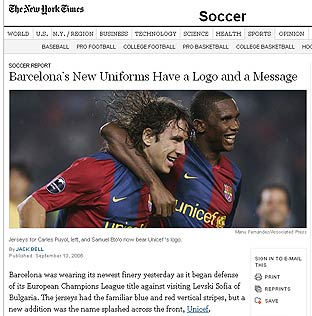 I've never been a big fan of Barcelona. Actually I just realized that their jerseys used to be "clean" (Oh.. so that's why they look so 'awkward'!). But now, I'll be paying more attention to them. And that is good marketing on Barcelona's part. Marketing aimed for the heart.
First photo credit: bbc.co.uk
Second photo credit: New York Times via here.
Monday, September 18, 2006
On being post-modern
Post-modernism, at a glance, may seem like a difficult, abstract concept. Books that reflect this idea seem absurd to read, as they analyze simple, banal things in manners that seem unnecessarily complex.
However, if there's one thing that I learned about post-modernism, it's the very simple concept that things are not as simple as they look, that there are a lot of factors that contribute to how things turn out, and even "how things turn out" depends on how one presents it.
History matters, but look again: who's point of view does it reflect? We thus should not be talking of History, but of histories. Gender matters, and thus even histories may be seen as "his stories," and therefore we should hear more of "her stories" to give a more complete picture. Race matters. If you don't recognize this since you're part of a racial majority in a certain place, go to another place where you're a minority. Then most likely you'll understand how you're being discriminated against, and how you, as part of a racial majority, may have discriminated against minorities. Geography matters. See how where you're born, where you work, and where your business is located decide how much money you have/make. You get my point.
Some people, who have been so accustomed to modernist, simplistic thinking, are frustrated by post-modernism. "If everything matters, then nothing really matters! Where do we even start?"
Well, that's the beauty of it, isn't it? Since many things matter, then we can start anywhere. However, we do need better leaders, who see a more complete picture, and are great at coordinating various sectors to achieve a common goal. The leader should also be more careful about making generalizing, over-arching statements, and only do so when it's really needed.
However, if there's one thing that I learned about post-modernism, it's the very simple concept that things are not as simple as they look, that there are a lot of factors that contribute to how things turn out, and even "how things turn out" depends on how one presents it.
History matters, but look again: who's point of view does it reflect? We thus should not be talking of History, but of histories. Gender matters, and thus even histories may be seen as "his stories," and therefore we should hear more of "her stories" to give a more complete picture. Race matters. If you don't recognize this since you're part of a racial majority in a certain place, go to another place where you're a minority. Then most likely you'll understand how you're being discriminated against, and how you, as part of a racial majority, may have discriminated against minorities. Geography matters. See how where you're born, where you work, and where your business is located decide how much money you have/make. You get my point.
Some people, who have been so accustomed to modernist, simplistic thinking, are frustrated by post-modernism. "If everything matters, then nothing really matters! Where do we even start?"
Well, that's the beauty of it, isn't it? Since many things matter, then we can start anywhere. However, we do need better leaders, who see a more complete picture, and are great at coordinating various sectors to achieve a common goal. The leader should also be more careful about making generalizing, over-arching statements, and only do so when it's really needed.
Monday, September 11, 2006
Easily Happy
If you were given a choice: happy or money, which would you pick? I'd guess many would answer both. And that's fine. I have nothing against money (heck, I like money); I just think it's over-rated. But think again: do we really need money to be happy?
Here's an anecdote my friend once told me:
A Western, white man finds a brown, indigeous Indonesian lying around on the beach, somewhere on the shores of Java. "Why aren't you working?" asked the white.
"Why should I?" asked the brown.
"So you can have money."
"What for?"
"So one day you can lie around on the beach, and enjoy life without worrying about anything."
"But I'm already doing that."
In Harry Potter #1, there's a story about a mirror. When one looks into this mirror, he will see himself in the form of what he desires most. For example, one sees himself receiving an award. Harry Potter sees himself besides his two deceased parents whom he never met. The happiest person just sees himself as he is.
Imagine you're looking into this mirror, and figure how much money is related to what you see. No, please really think about it. You want self-esteem? Then treat people respectfully. You want a new experience? Go interact with people you'd never thought you would. You want to feel good? Give something that you value to a nice person who needs it more than you do. Then forget about what you've done.
Paradoxically, happiness is easiest to achieve by giving something away. So go ahead: make dinner for your wife. Recite a poem for your partner. Win a basketball game for your boyfriend. Give her a massage. Do it wholeheartedly. Now you see what I'm talking about.
One of my mentors, Kang Didi, has a really cool catch-phrase: "gampang senang" (easily happy). And he's right: happiness is easy to find. It's all in our minds. Money sure is valuable. Just don't forget to be happy while you pursue it.
Previous posts on happiness: 1, 2, 3, 4
Here's an anecdote my friend once told me:
A Western, white man finds a brown, indigeous Indonesian lying around on the beach, somewhere on the shores of Java. "Why aren't you working?" asked the white.
"Why should I?" asked the brown.
"So you can have money."
"What for?"
"So one day you can lie around on the beach, and enjoy life without worrying about anything."
"But I'm already doing that."
In Harry Potter #1, there's a story about a mirror. When one looks into this mirror, he will see himself in the form of what he desires most. For example, one sees himself receiving an award. Harry Potter sees himself besides his two deceased parents whom he never met. The happiest person just sees himself as he is.
Imagine you're looking into this mirror, and figure how much money is related to what you see. No, please really think about it. You want self-esteem? Then treat people respectfully. You want a new experience? Go interact with people you'd never thought you would. You want to feel good? Give something that you value to a nice person who needs it more than you do. Then forget about what you've done.
Paradoxically, happiness is easiest to achieve by giving something away. So go ahead: make dinner for your wife. Recite a poem for your partner. Win a basketball game for your boyfriend. Give her a massage. Do it wholeheartedly. Now you see what I'm talking about.
One of my mentors, Kang Didi, has a really cool catch-phrase: "gampang senang" (easily happy). And he's right: happiness is easy to find. It's all in our minds. Money sure is valuable. Just don't forget to be happy while you pursue it.
Previous posts on happiness: 1, 2, 3, 4
Monday, August 28, 2006
The cost of freedom (apparently not that expensive)
How much money do you think you have to own (or is 'enough') to enable you to be 'free'? For Indra, an ex-taxi driver in Jakarta, it's 11 million rupiahs (~ USD 1,200). [Some of you may be saying... "hey, I have that kind of money!"]
Indra's story was told by Martinus, another taxi driver from the same company, whose taxi I rode in yesterday.
Martinus told that Indra is a fine, honest, very-likeable man. One day, a drunk got in to Indra's taxi and left a small luggage on the backseat. Later, Indra opened the luggage to look for an address or telephone number. He found it alright, but to his amazement, he also found 300 million rupiahs (~ USD 33,300) of cash. Being an honest person, Indra gave the luggage to the taxi 's management. The management then called the person who lost the luggage. In short, the person came, claimed his luggage, (maybe gave some money to the management), and gave 11 million rupiahs to Indra.
Indra was happy as hell. He immediately said goodbye to Jakarta, returned to his village in Kabupaten Semarang, and opened up a restaurant. Today (3-4 years later), he'd sometimes come to Jakarta to see his old cabby mates and tell stories of his successful restaurant and happy life. Sometimes he'd give money to those who are needing it.
Martinus was 'honest' as well. He told me, "if I found that kind of cash left on my backseat, I wouldn't give it to the management. I'd return the taxi to its pool, say goodbye to my cabby mates, and run away with the money."
"And what would you do?" I asked.
"I'd return to my village in the Kupang area (in NTT), and open a restaurant as well. My wife is a great cook!"
Hmm...
Wouldn't you be interested to know how many people are actually living & working in big cities ONLY because they have no other choice? Despite all the talk of how great cities are, its important role in the economy, and how we should support villagers/the poor who want to come to the city (and I do believe in these), it's heartwarming to hear stories like Indra's and Martinus'. They make me think again, and again: "am I doing /promoting the right thing?" They keep me in praxis.
Indra's story was told by Martinus, another taxi driver from the same company, whose taxi I rode in yesterday.
Martinus told that Indra is a fine, honest, very-likeable man. One day, a drunk got in to Indra's taxi and left a small luggage on the backseat. Later, Indra opened the luggage to look for an address or telephone number. He found it alright, but to his amazement, he also found 300 million rupiahs (~ USD 33,300) of cash. Being an honest person, Indra gave the luggage to the taxi 's management. The management then called the person who lost the luggage. In short, the person came, claimed his luggage, (maybe gave some money to the management), and gave 11 million rupiahs to Indra.
Indra was happy as hell. He immediately said goodbye to Jakarta, returned to his village in Kabupaten Semarang, and opened up a restaurant. Today (3-4 years later), he'd sometimes come to Jakarta to see his old cabby mates and tell stories of his successful restaurant and happy life. Sometimes he'd give money to those who are needing it.
Martinus was 'honest' as well. He told me, "if I found that kind of cash left on my backseat, I wouldn't give it to the management. I'd return the taxi to its pool, say goodbye to my cabby mates, and run away with the money."
"And what would you do?" I asked.
"I'd return to my village in the Kupang area (in NTT), and open a restaurant as well. My wife is a great cook!"
Hmm...
Wouldn't you be interested to know how many people are actually living & working in big cities ONLY because they have no other choice? Despite all the talk of how great cities are, its important role in the economy, and how we should support villagers/the poor who want to come to the city (and I do believe in these), it's heartwarming to hear stories like Indra's and Martinus'. They make me think again, and again: "am I doing /promoting the right thing?" They keep me in praxis.
Friday, August 25, 2006
In Defense of Ghost-blogging
A. Fatih Syuhud criticizes those who blog anonymously (apparently this is not the first time). I think there are many legitimate reasons to support those who chose to "ghost blog." Unfortunately, only one seem to be acknowledged by Fatih: security.
So I'm putting forward three points (not in order of importance) to refute his argument.
First point: about authority. What makes the Internet (including blogging) interesting for many people is that there are very few rules. For the large part, the Internet is (still) a free world. Sure there are ethics, but I think they should be applied forcefully only to issues that are damaging (such as spam), not issues such as "linking back," as Fatih said here:
Second point: about Narcisism. I'm NOT apposed to it, but isn't that a bias in itself? Delicate, Delightful, Delicious said (my own translation):
Third point, let me support nad's note on the issue of objectivity. As Nad wrote, there are two opinions on objectivity:
If such post is critical of Indonesia, then would you think that the former is objective and credible, while the latter is biased? If such post is critical of the foreigner's country of origin, then would you think that the foreigner is objective, and the Indonesian is biased?
We can apply this to many things: nationality, religion, gender, what have you. The truth is, not every person is a fundamentalist. I am a Muslim, but at certain times I can be very critical of other Muslims, and other times supportive. Why? Because another part of me is liberal, and another part socialist, etc., which may - sometimes - contradict with Islam. I am pro marginal communities, though I come from a well-off family. I work in a field that champions the use of ICT and hails "the death of geography," but is a fan of urban studies and learned that geography/space is still alive and kicking (ICT even makes geography more important than ever!). I'm sure I'm not the only one who lives with inner contradictions.
I'm sure Fatih means well. But hope this contributes to keeping the internet and blogging a free world.
So I'm putting forward three points (not in order of importance) to refute his argument.
First point: about authority. What makes the Internet (including blogging) interesting for many people is that there are very few rules. For the large part, the Internet is (still) a free world. Sure there are ethics, but I think they should be applied forcefully only to issues that are damaging (such as spam), not issues such as "linking back," as Fatih said here:
this is one of unwritten conventional rule in blogger world: whenever someone link your blog, you're obliged to link it back.Since when is blogging full of "rules" and "obligations"? Conventions, maybe. Consider this: saying "thank you" is not common in many Indonesian villages (unless you actually give them something), but we'd more likely get a smile or a nod instead. Or, my Japanese friend told me that there is no "please" in Japanese language. Or, I had a hard time finding the Javanese expression for "excuse me."
Second point: about Narcisism. I'm NOT apposed to it, but isn't that a bias in itself? Delicate, Delightful, Delicious said (my own translation):
People say, welcome to the era of narcisism. This saying refers to blogs and their increasing quantity and popularity.Fatih is acknowledging this just fine, by saying
Indonesian bloggers tend to make their blogs and their names known in the google world and are proud to see their traffic achieves PG (page ranking) four plus. ...
I hardly found any Indonesian bloggers whose pictures, true full names and CVs are not attached in their blogs.And this:
blogger is an ego-driven medium, a self-publishing means and a self-satisfying "lust" of own-self existence. Let's be honest about it.I agree, to a certain extent. But I think your statements may be pushing it too far (they don't apply to everyone). And some bloggers may NOT like to hear that blogging is identical with narcisism.
Third point, let me support nad's note on the issue of objectivity. As Nad wrote, there are two opinions on objectivity:
1. a work cannot possibly have been made in void and thus better understanding can derive from understanding and knowledge of the background of the very person behind the work itself.Let me ask Fatih: If you knew beforehand that a post is written by an anonymous foreign blogger, then would you view it "differently" than a post written in the same tone by an open-identity Indonesian?
2. the work itself should be the main focus of attention. Once a work is released to public domain, it thus becomes public and its interpretation therefore rests with the eyes of each beholder.
If such post is critical of Indonesia, then would you think that the former is objective and credible, while the latter is biased? If such post is critical of the foreigner's country of origin, then would you think that the foreigner is objective, and the Indonesian is biased?
We can apply this to many things: nationality, religion, gender, what have you. The truth is, not every person is a fundamentalist. I am a Muslim, but at certain times I can be very critical of other Muslims, and other times supportive. Why? Because another part of me is liberal, and another part socialist, etc., which may - sometimes - contradict with Islam. I am pro marginal communities, though I come from a well-off family. I work in a field that champions the use of ICT and hails "the death of geography," but is a fan of urban studies and learned that geography/space is still alive and kicking (ICT even makes geography more important than ever!). I'm sure I'm not the only one who lives with inner contradictions.
I'm sure Fatih means well. But hope this contributes to keeping the internet and blogging a free world.
Saturday, August 19, 2006
A universalist reflection on Indonesia’s independence
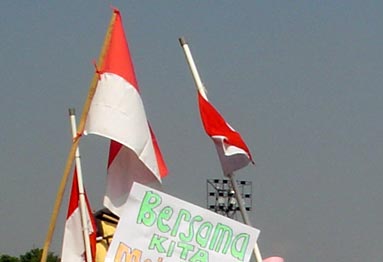 During my college years, Indonesia's independence day celebration every August 17th was always coupled with ITB students rallying to say that "we're NOT really independent." Of course, those were the days of Suharto; and they were criticizing Suharto's regime. Now, after ten or so years have passed, what does independence day mean to me? Apparently I've put less weight on nationalism, and more weight on independence as a prerequisite for interdependence.
Why do many people think nationalism is so important? When I was in L.A., independence day celebrations at the Consulate were often coupled by protests by the pro-independence Mollucans and Papuans. I also remember participating in an AMARC conference in Jakarta last year, where a participant from Timor Leste explained how proud she was of Timor Leste's independence from Indonesia. Whereas in Indonesia, so-called nationalists raged about Timor Timur’s break-out. Can nationalism hurt? Apparently so.
I am NOT an advocate of disintegration. But if a certain people think they can live better off by themselves, and not beneath another's wings, then why not? Who are we to say that they should be a part of us when the feeling's not mutual? Nationalism is a state of mind. Anderson said that it's "imagined." After Indonesia gained independence, Sukarno had to work hard to build the nation. And to a large extent, he was successful. But time moves on, leaders change, policies change, distribution of wealth gets to be unfair, and administration corrupts. Who is then to blame for the thinning of Indonesia's nationalism? Nationalism, as a state of mind, should be earned, not imposed on.
Why am I so lenient on nationalism?
- because I believe today is the era of interdependence, not independence. However, to be interdependent, each and every component involved must be essentially independent (this is from Covey, and often reminded to me by my friend Alex Lai). I think Indonesia (as a region) and any other region in the world would work better with the principle of interdependence. To achieve this, if some areas feel that they need to have their independence first, then be it. Any area that breaks out from Indonesia (given the break-out was peaceful and left no grudge) would eventually need to cooperate with Indonesia. In the end, they would still be a part of "us," just wearing a different "jacket."
- because first and foremost I care about the people, then secondly, the country. Humanism, brotherhood, sisterhood, or whatever word fits this concept, is universal; it knows no boundaries.
Having said that, independence (aka freedom) has its own virtues. Amartya Sen said that this should be the core of "development" (Development as Freedom). Sick of enomomics-oriented developmentalists putting too much emphasis on economic growth as the core of development, Sen rebutted by saying that the goal and the means of development should be five freedoms:
- political freedoms
- social facilities
- economic opportunities
- transparency guarantees
- protective security
By achieving one type of freedom, we increase our chances of achieving another. In essence, these freedoms enable people "to live a life that they value, and not a life that others value." Unfortunately, as Enda pointed out, for the poor, there are obstructions to achieve these freedoms. Thus the poor face unfreedoms which need to be removed.
So this weekend, I celebrate Indonesia's independence day to remind me how:
- I am proud to be a part of the Indonesian people
- I, as an Indonesian citizen, knowingly or unknowingly, may impose unfreedoms on other peoples, and I am sorry for that
- many people of the world are still facing tremendous unfreedoms, maybe not so much because of their nationality, but more likely because of their race, class, gender, and religion. If these people form a nation, then that’s the “nation” I want to be associated with
- by enabling people to achieve freedoms, they can live a life that really matters to them, based on their own standards and measures. Then, together we can build an interdependent relationship that's genuine and long-lasting.
technorati tags: politics, opinion, development
Friday, August 18, 2006
Hate Cartoons and Double-standards
An international cartoon exhibition on the hollocaust is being conducted at a museum in Tehran, Iran. Republika reported that the event is to get even at "the West" for the Muhammad cartoons on the Danish daily Jyland-Posten, or at least to challenge the double standard applied to free speech when dealing with religious issues.
Earlier this year (shortly after the Muhammad cartoons), Saskia Sassen wrote that in a time of war, "free speech" is a contested issue. Indeed, this condition has made us brought in to "a new frontier-zone."
Many discussions about this issue, such as shown here, just proves that a particular issue may be a laughing matter for one person (a "light" issue), while at the same time it's hurtful (a "serious" issue) for another person.
For me, intentionally hurting anyone's feelings and beliefs (not just in terms of religion, but also race, gender, etc) is a mean act. In this case, I consider the anti-Islam, anti-Semit, anti-gay, white supremacists, and other fundamentalists mean. But imposing a double standard to cover one's own fundamentalism, that's hypocricy, and it may well be meaner.
Earlier this year (shortly after the Muhammad cartoons), Saskia Sassen wrote that in a time of war, "free speech" is a contested issue. Indeed, this condition has made us brought in to "a new frontier-zone."
Frontier-zones are spaces of imbrication. They are not lines where civilisations clash. They are areas of hybridity. What liberal democracies are experiencing is the limits of their closure and of the presumption that the world should like the way they look.So what are the boundaries of "free speech" and "hate speech"? Even in the U.S., these boundaries have been defined only recently, and "through struggle." Still, double standards apply. Masoud Shojai, head of the Iranian Cartoonist Association said, "They can write whatever they please about our Prophet (Muhammad, PBUH). But when one person questioned about the Hollocaust, they are fined, even imprisoned." Republika reported that David Irving, an English historian, and Frederick Toben, an Australian hostorian, have had to stay in the cells for being skeptical about the hollocaust.
Many discussions about this issue, such as shown here, just proves that a particular issue may be a laughing matter for one person (a "light" issue), while at the same time it's hurtful (a "serious" issue) for another person.
For me, intentionally hurting anyone's feelings and beliefs (not just in terms of religion, but also race, gender, etc) is a mean act. In this case, I consider the anti-Islam, anti-Semit, anti-gay, white supremacists, and other fundamentalists mean. But imposing a double standard to cover one's own fundamentalism, that's hypocricy, and it may well be meaner.
Wednesday, August 16, 2006
On Local wisdoms
The best take on local wisdoms I've read lately comes from the arts scene.
 Last Sunday, Kompas featured Sardono Kusumo, a well-respected Indonesian dancer. Sardono re-examined (or rather 'day-dreamed'/ngelamun) about Indonesia's geographic position in the Pacific Ring of Fire and what it means for its civilization. He thought that the term "tanah air" (literally meaning "soil and water"), that Sukarno coined as a loose alternative for the word "country," does not only signify the conceptual, but also the real.
During the era of classic Indonesian kingdoms, the locations of these kingdoms move about, probably due to earthquake and tsunami impacts. The partly-destructed and burried condition of Borobudur and Prambanan temples at the time they were founded by the Dutch may also strengthen this hypothesis. The term "tanah air" thus may have been a call to Indonesia to give proper attention to its soil and water, as her life depends much on them.
In another article, the daily profiled an exhibition titled "Understanding Merapi," in which the Merapi Community calls for better understanding of the different perceptions when dealing with the volcano.
 Last Sunday, Kompas featured Sardono Kusumo, a well-respected Indonesian dancer. Sardono re-examined (or rather 'day-dreamed'/ngelamun) about Indonesia's geographic position in the Pacific Ring of Fire and what it means for its civilization. He thought that the term "tanah air" (literally meaning "soil and water"), that Sukarno coined as a loose alternative for the word "country," does not only signify the conceptual, but also the real.
During the era of classic Indonesian kingdoms, the locations of these kingdoms move about, probably due to earthquake and tsunami impacts. The partly-destructed and burried condition of Borobudur and Prambanan temples at the time they were founded by the Dutch may also strengthen this hypothesis. The term "tanah air" thus may have been a call to Indonesia to give proper attention to its soil and water, as her life depends much on them.
In that case, should (Indonesian) modernity be redefined?Sardono's picture taken from Asialink, Univ. of Melbourne.
"Yes, because much (of it) contradicts the character of where we build lives with such soil and water."
In another article, the daily profiled an exhibition titled "Understanding Merapi," in which the Merapi Community calls for better understanding of the different perceptions when dealing with the volcano.
For thousands of years harmony has been created between the Merapi community and the volcano through a mutual way of life. The people gain their livelihood from Merapi and, in turn, the mountain's nature is preserved by the people. This bond between human and nature was destructed during the evacuation phases. The sensitivity of people's intuition were put aside because they were considered irrational.This quote reminded me of one of my favorite books, Staying Alive, by Vandana Shiva. Here Shiva said that modernism and its brain-child, "development," has largely destructed nature, and marginalized women's ways of knowing, such as through intuition and story-telling, and replaced them with the so-called rationality.
Saturday, August 12, 2006
Kompas: Sulak Sivaraksa on development and buddhism with a 'b'
 Last week, Kompas featured an inspiring interview with Sulak Sivaraksa, a complete individual, playing various roles simultaneously. Or as Kompas puts it: a "philosopher, spiritualist, activist, social critique, and intellectual rebel, holding firmly to the Buddhist non-violence ethics," who has for many years become a "professional" pain for the Thai government.
Here are some quotes from the interview (my own translation):
As long as development is measured by material success, greed will continue to create tension, conflict, and humans will keep fighting for profit by hurting each other.And this is my favorite one, put at the end of the article:
"We are pressured to satisfy our wants by buying, buying, owning, owning, and owning more. 'To own' becomes more important than 'to be'. Consumptivism has exploited the mind and body of the young generation."
The modern education system within capitalism produces cleverness without wisdom. "The values of education no longer love goodness, but competition." And in competition, people don't only face each other, but also nature.
"We should practice buddhism with the letter 'b', love life, peace, and reject violence."
"Life is fun, you know..."I hear you, Acharn (teacher) Sulak.
Subscribe to:
Posts (Atom)