Friday, June 30, 2006

What population?


At the end of the "Future of Cities" session, someone asked why population matters (e.g. family planning) was NOT dealth with enough during the World Urban Forum. Obviously, she was concerned about population pressure.

David Satterthwaite, however, gave a really blunt answer. He said:
"Population is not the problem. The problem is Donald Trump. We can fit the whole world's population in an area as big as Senegal, at the density of Chelsea. And, Chelsea is a pretty nice place..."

Thursday, June 15, 2006

More Ikhlas, please!

The Muslims have a word that I like a lot: ikhlas, meaning to give something without wanting anything in return. A close English comparison is maybe sincere, but ikhlas also means pure. Someone told me before that being ikhlas is like going to the toilet to poop or pee. You don't ever think of what happens to it next. You give something away to someone who needs it, and you forget about it. You never expect it to return in your favor the next day.

In the context of disaster relief and reconstruction, it seems that Indonesia - well, Bantul people in Yogyakarta, at least (maybe learning from the Aceh experience) - are sick and tired of people giving "aid" when they really want to:
  1. give loan
  2. convert someone to another religion
  3. win political support
  4. promote themselves (too much), for whatever reason
In the Bantul People's Asembly last Tuesday, the Indonesian flag stood proud and at full-height, instead of the usual half-hight to symbolize mourn.

Emha Ainun Najib said, "If anyone wants to help Bantul, then help. You don't need to "brag" about yourself. As from now on, I'd only like to see the Red and White Flag standing in Bantul. Let there be no other flags, be it political parties' or any other organization that's trying to take advantage of people's misery." Suara Merdeka and Republika reported.

Conversation with a Taxi Driver

We arrived in Vancouver this afternoon, and took the taxi to the University of British Columbia. Our driver was of Somalian-origin, who instantly said "Assalamu'alaikum" after he found out that we were from Indonesia.

I remember two things that he said, responding to our being here on United Nations business.

One is that UN Headquarters should move from New York to Vancouver (or anywhere but the US), so that the UN would not be biased to US interests, and that it would stop "changing diapers" for the US.

Another is that he's not interested in working for the UN. Especially if their actions keep tending to back (or at least legitimize) the US' "mistakes."

Wednesday, June 07, 2006

Clearing House = To Clear Rubbles ?


We have a problem.
It's over-usage of "the language of gods" (bahasa dewa), while in reality we often interact with people who talk "the language of folks" (bahasa kawula).

Combine has listed itself at the Disaster Coordination Unit as an agency that provides "clearing house" service. As a result, for the past few days I've received calls from people who asked for shovels and even backhoes.

OK. I'm exaggerating. Not backhoes... (yet)

I felt like smiling, but then I remember these are people who've maybe lost their houses. So I swallowed that smile, and explained to them patiently what we really do...

Tuesday, June 06, 2006

"Community, Communication, Cartography"

Pak Baiquni from Geography UGM has a new slogan that has stayed in my head for the past several days: "Three C's (Community, Communication, Cartography)." I think part of it reflects the academia's self-interest to prove its role in times of emergency. Another part reflects a comprehensive thought at how data & information are communicated and presented to and from the people most affected.

So this is what the geography folks are doing: some volunteers are out in the field collecting data directly from community groups, others work with (commercial) radio stations to collect data from the people who call-in to request for aid, others then map the data into web GIS. In the beginning I thought, "Great - data is collected, and then mapped. So what?" It's relief agencies who are going to use the maps more. Great idea, but nothing new.

But last night he said that "Three C's" work the other way around, too: so it's Cartography, Communication, Community. Data and information laid out on maps will then be communicated back to the community. A two-way flow!

I'm excited. Let's see how it all rolls.

Database, Interests, and Acquaintance

This summary is not available. Please click here to view the post.

Thursday, June 01, 2006

Disaster Coordination Unit

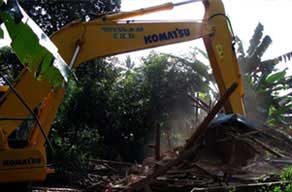
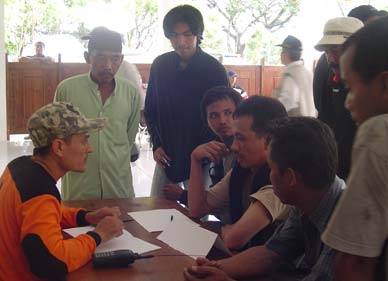
I'm probably not going to write news-style reports about the 27 May earthquake & its aftermaths here. However, let me share some photos from my trip to the Disaster Coordination Unit (Satlak) in Bantul, a few days ago.

"We want to help!":the volunteer recruitment desk

"People in my neighborhood need help! Here are their names..."

"Here you go... A bag full of goodies for everyone."

And here's a list of some sites with information on the quake. Note that much content is in Indonesian:

Tuesday, May 30, 2006

Friedman vs Galbraith

This month, HBS Working Knowledge's "What do YOU think?" compares & contrasts two great economists: John Kenneth Galbraith and Milton Friedman. One a Keynesian and institutionalist, the other a proponent of laissez-faire capitalism.

As I expected, the column & sum-up of discussion tilted towards Friedman (this was acknowleded by Prof. Heskin, the host). Well, I shouldn't be surprised. This is Harvard Business School, and good chunk of participants were managers, directors, owners, etc. of big businesses.

However, I'm also relieved to read this bit from Heskin:

I was struck by the number of respondents who suggested that the ideas of both Friedman and Galbraith had relevance, perhaps at different times and in different places. Henry Kwok wrote, "They brought to us two perspectives—the need for freedom to choose and the need for the government to provide an order to the economy. We cannot live with one without the other." Kamal Gupta noted that, "in the case of an economy that is coming out of poverty, like India . . . [the ideas of Galbraith] would provide for a faster redistribution of wealth. But once the economy reaches a certain threshold . . . the state should move to minimize its involvement."

And quite amused to read this one from a participant:

The real strength of the free world is not in its freedoms but in its ability to reach compromise. From that angle, Galbraith (like Keynes before him) would appear to me to be more relevant in the future. Rosy socialism was a mistake and Friedman's great role was to help stop the world from going there. Galbraith's views are more inclusive and require us to look at the social responsibilities of the successful.

As a foreigner, an HBS graduate, and an admirer of America, I find that we may now be drifting too far to the right. Viva Galbraith.

People's Media and Public Services

The BRIDGE (Building and Reinventing Decentralized Governance) project is finally interested in the voice of the people to improve public services in Sulawesi. After more than a year, now they want to build a multi-stakeholder knowledge management strategy. And community radios will be at part of this. About time! The problem with our precarious public services, though, was never in the voice of the people (or a seeming lack of it). But rather the inability of government - and their private sector partner - to listen to them.

Communication is really at the center of governance. Whether a government agency is transparent or closed, accountable or corrupt, can be seen by how they communicate. Do they gather inputs, or just disseminate? Do they listen, or just talk? A pro-poor communication system is one that makes, or forces, the government to listen to the people.

"Cities, Magnets of Hope"


Titled above is World Habitat Day theme for this year. It's clear that the role of cities and of urbanization remains and will probably stay at the center of international concern for human settlement. See the list of WHD themes for the past 20 years. For the last 11 years we've moved on from "shelter" and really focused on "cities".

BTS at the discussion in URDI this morning underscores not just the growth of large cities and the losing out of villages, but also the shrinking of (small) towns. There's no more hierarchy of cities. There's only (big) cities and everything else. SW said villagers nowadays don't move to a small town before they move to a big city; they come straight to Jakarta ("tembak langsung"). DJ said that urbanization is unstoppable. Governments need to prepare for this condition and provide adequate services for the poor coming in to the cities.

I see cities NOT as "magnets", but rather they are the ONLY "hope" left. Cities (or urban interests) have engineered it this way. Lefebvre said the rural is now part of the urban. And this, Storper & Walker said, is the "capitalist imperative".