Saturday, July 01, 2006

Happiness, again

I'm not quite done with happiness. And, apparently, neither have 900 Harvard students who attend Tal Ben-Shahar's class twice a week to learn "how to get happy." The class, Psychology 1504, or Positive Psychology, seemed to have become the most popular course on campus.
The course focuses on the psychological aspects of a fulfilling and flourishing life. Topics include happiness, self-esteem, empathy, friendship, love, achievement, creativity, music, spirituality, and humor.
And don't forget to click that first link to get Six Tips for Happiness a la Ben-Shahar.

Technorati technorati tags: ,

Of happiness and/or wealth

Here's another reason to support my thesis that happiness and income-level/wealth does NOT necessarily go together.
Economist Alan Krueger and psychologist and Nobel laureate in economics Daniel Kahneman have found, using a newly developed analytical technique, that people with above-average incomes do not necessarily spend more time doing things they enjoy.
And what do they enjoy?
People, regardless of their income, are happier when they're socializing than when they're doing work around the house. They're happier when they're doing active leisure-type activities than when they're watching TV.
This may correlate to the condition that high income-earners face: they have to work longer hours than their lower-income counterparts.

During most of the 1900s, the hours of work declined for most American men. But around 1970, the share of employed men regularly working more than 50 hours per week began to increase...

This shift was especially pronounced among highly educated, high-wage, salaried, and older men. For college-educated men, the proportion working 50 hours or more climbed from 22.2 percent to 30.5 percent in these two decades.
Ouch, I'd say.

Guess that's why Bhutan's King Jigme Singye Wangchuck in 1972 created the term Gross National Happiness. Here's a link to a set of papers related to GNH from the Center for Bhutan Studies. There's also a project that promotes Gross International Happiness.

Now, wouldn't you wanna be one of the happy ones? :)

Technorati technorati tags: , ,

Loyal, smart, or honest

It seems that India is in more than one way similar to Indonesia. Take this post from India Uncut, for example:
I find from the Times of India that the chief minister of Bihar gets a basic salary of Rs 2000 per month -- less than that of a government peon -- though with perks it goes up to around Rs 25,000. You combine that relatively low salary with immense power and discretion -- and therefore opportunities to be corrupt -- and it's virtually a guarantee that the field of politics will attract either losers or thugs. And obviously the thugs will beat the losers.

Back in Indonesia, we have an anecdote that goes: "A government worker can have either two of these three qualities: loyal, smart, OR honest. One cannot have all three."

Of course, this does not apply to all.

Friday, June 30, 2006

What population?


At the end of the "Future of Cities" session, someone asked why population matters (e.g. family planning) was NOT dealth with enough during the World Urban Forum. Obviously, she was concerned about population pressure.

David Satterthwaite, however, gave a really blunt answer. He said:
"Population is not the problem. The problem is Donald Trump. We can fit the whole world's population in an area as big as Senegal, at the density of Chelsea. And, Chelsea is a pretty nice place..."

Thursday, June 15, 2006

More Ikhlas, please!

The Muslims have a word that I like a lot: ikhlas, meaning to give something without wanting anything in return. A close English comparison is maybe sincere, but ikhlas also means pure. Someone told me before that being ikhlas is like going to the toilet to poop or pee. You don't ever think of what happens to it next. You give something away to someone who needs it, and you forget about it. You never expect it to return in your favor the next day.

In the context of disaster relief and reconstruction, it seems that Indonesia - well, Bantul people in Yogyakarta, at least (maybe learning from the Aceh experience) - are sick and tired of people giving "aid" when they really want to:
  1. give loan
  2. convert someone to another religion
  3. win political support
  4. promote themselves (too much), for whatever reason
In the Bantul People's Asembly last Tuesday, the Indonesian flag stood proud and at full-height, instead of the usual half-hight to symbolize mourn.

Emha Ainun Najib said, "If anyone wants to help Bantul, then help. You don't need to "brag" about yourself. As from now on, I'd only like to see the Red and White Flag standing in Bantul. Let there be no other flags, be it political parties' or any other organization that's trying to take advantage of people's misery." Suara Merdeka and Republika reported.

Conversation with a Taxi Driver

We arrived in Vancouver this afternoon, and took the taxi to the University of British Columbia. Our driver was of Somalian-origin, who instantly said "Assalamu'alaikum" after he found out that we were from Indonesia.

I remember two things that he said, responding to our being here on United Nations business.

One is that UN Headquarters should move from New York to Vancouver (or anywhere but the US), so that the UN would not be biased to US interests, and that it would stop "changing diapers" for the US.

Another is that he's not interested in working for the UN. Especially if their actions keep tending to back (or at least legitimize) the US' "mistakes."

Wednesday, June 07, 2006

Clearing House = To Clear Rubbles ?


We have a problem.
It's over-usage of "the language of gods" (bahasa dewa), while in reality we often interact with people who talk "the language of folks" (bahasa kawula).

Combine has listed itself at the Disaster Coordination Unit as an agency that provides "clearing house" service. As a result, for the past few days I've received calls from people who asked for shovels and even backhoes.

OK. I'm exaggerating. Not backhoes... (yet)

I felt like smiling, but then I remember these are people who've maybe lost their houses. So I swallowed that smile, and explained to them patiently what we really do...

Tuesday, June 06, 2006

"Community, Communication, Cartography"

Pak Baiquni from Geography UGM has a new slogan that has stayed in my head for the past several days: "Three C's (Community, Communication, Cartography)." I think part of it reflects the academia's self-interest to prove its role in times of emergency. Another part reflects a comprehensive thought at how data & information are communicated and presented to and from the people most affected.

So this is what the geography folks are doing: some volunteers are out in the field collecting data directly from community groups, others work with (commercial) radio stations to collect data from the people who call-in to request for aid, others then map the data into web GIS. In the beginning I thought, "Great - data is collected, and then mapped. So what?" It's relief agencies who are going to use the maps more. Great idea, but nothing new.

But last night he said that "Three C's" work the other way around, too: so it's Cartography, Communication, Community. Data and information laid out on maps will then be communicated back to the community. A two-way flow!

I'm excited. Let's see how it all rolls.

Database, Interests, and Acquaintance

This summary is not available. Please click here to view the post.

Thursday, June 01, 2006

Disaster Coordination Unit

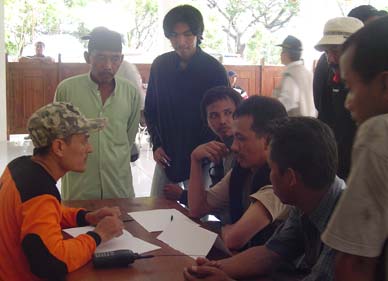
I'm probably not going to write news-style reports about the 27 May earthquake & its aftermaths here. However, let me share some photos from my trip to the Disaster Coordination Unit (Satlak) in Bantul, a few days ago.

"We want to help!":the volunteer recruitment desk

"People in my neighborhood need help! Here are their names..."

"Here you go... A bag full of goodies for everyone."

And here's a list of some sites with information on the quake. Note that much content is in Indonesian: