Friday, August 18, 2006

Low Income Flats: More Polemics

Ever since Jusuf Kalla's statement, low-income vertical housing (flats) are gaining attention. Jakarta's Deputy Governor Fauzi Bowo rebutted the VP's call to build 20-storey flats in all cities with more than 2 million. He said, "to build flats we need a wide area. We just don't have that kind of land in the middle of the city." Fathi R Shidiq from the Parliament exacerbated the logic of this whole argument by saying "if the government forces its will to build low-income flats in the middle of the city, then get ready to confront the urban poor."

What interesting statements. Here's my response:
  1. To Mr. Bowo: Isn't vertical housing invented as a solution to the issue of land shortage? Your reason to disagree with flats is all the more reason to build it.
  2. To Mr. Shidiq: Won't these flats be built FOR the urban poor? If they can still stay in the same strategic area of the city, with secure tenure, then why should they oppose it? Unless you're saying that usually what happens is that the poor previously living in the area get evicted, and that the flats in the end are occupied by the middle class...
It seems like building these flats is not as simple as the VP may have thought, eh?

PS:
1) Pak Darrundono, in another article, provided the more institutional and cultural challenges of flats provision. These include such flats being too product oriented, too expensive, exclusive to the private sector and tenants, weak on management, opposes the principle of government as "enabler," transplanted into Indonesia from other cultures, are difficult to accept by the low-income population since to live in such flats, hey have to undergo a sudden change of culture.
2) Another article profiles Jakarta's attempt to redevelop the Pulomas flats in Jakarta into a middle class settlement.
3) Photo above portrays the chaotic utility (water) pipes in the Penjaringan Flats.

Technorati technorati tags: , ,

Hate Cartoons and Double-standards

An international cartoon exhibition on the hollocaust is being conducted at a museum in Tehran, Iran. Republika reported that the event is to get even at "the West" for the Muhammad cartoons on the Danish daily Jyland-Posten, or at least to challenge the double standard applied to free speech when dealing with religious issues.

Earlier this year (shortly after the Muhammad cartoons), Saskia Sassen wrote that in a time of war, "free speech" is a contested issue. Indeed, this condition has made us brought in to "a new frontier-zone."
Frontier-zones are spaces of imbrication. They are not lines where civilisations clash. They are areas of hybridity. What liberal democracies are experiencing is the limits of their closure and of the presumption that the world should like the way they look.
So what are the boundaries of "free speech" and "hate speech"? Even in the U.S., these boundaries have been defined only recently, and "through struggle." Still, double standards apply. Masoud Shojai, head of the Iranian Cartoonist Association said, "They can write whatever they please about our Prophet (Muhammad, PBUH). But when one person questioned about the Hollocaust, they are fined, even imprisoned." Republika reported that David Irving, an English historian, and Frederick Toben, an Australian hostorian, have had to stay in the cells for being skeptical about the hollocaust.

Many discussions about this issue, such as shown here, just proves that a particular issue may be a laughing matter for one person (a "light" issue), while at the same time it's hurtful (a "serious" issue) for another person.

For me, intentionally hurting anyone's feelings and beliefs (not just in terms of religion, but also race, gender, etc) is a mean act. In this case, I consider the anti-Islam, anti-Semit, anti-gay, white supremacists, and other fundamentalists mean. But imposing a double standard to cover one's own fundamentalism, that's hypocricy, and it may well be meaner.

Technorati technorati tags: ,

Wednesday, August 16, 2006

On Local wisdoms

The best take on local wisdoms I've read lately comes from the arts scene.

Last Sunday, Kompas featured Sardono Kusumo, a well-respected Indonesian dancer. Sardono re-examined (or rather 'day-dreamed'/ngelamun) about Indonesia's geographic position in the Pacific Ring of Fire and what it means for its civilization. He thought that the term "tanah air" (literally meaning "soil and water"), that Sukarno coined as a loose alternative for the word "country," does not only signify the conceptual, but also the real.

During the era of classic Indonesian kingdoms, the locations of these kingdoms move about, probably due to earthquake and tsunami impacts. The partly-destructed and burried condition of Borobudur and Prambanan temples at the time they were founded by the Dutch may also strengthen this hypothesis. The term "tanah air" thus may have been a call to Indonesia to give proper attention to its soil and water, as her life depends much on them.
In that case, should (Indonesian) modernity be redefined?

"Yes, because much (of it) contradicts the character of where we build lives with such soil and water."
Sardono's picture taken from Asialink, Univ. of Melbourne.


In another article, the daily profiled an exhibition titled "Understanding Merapi," in which the Merapi Community calls for better understanding of the different perceptions when dealing with the volcano.
For thousands of years harmony has been created between the Merapi community and the volcano through a mutual way of life. The people gain their livelihood from Merapi and, in turn, the mountain's nature is preserved by the people. This bond between human and nature was destructed during the evacuation phases. The sensitivity of people's intuition were put aside because they were considered irrational.
This quote reminded me of one of my favorite books, Staying Alive, by Vandana Shiva. Here Shiva said that modernism and its brain-child, "development," has largely destructed nature, and marginalized women's ways of knowing, such as through intuition and story-telling, and replaced them with the so-called rationality.

Technorati technorati tags: , ,

Sunday, August 13, 2006

When Indonesia's VP and Jakarta's Governor Exchange Statements about Low-income Flats

Yusuf Kalla was again premature, while Sutiyoso was again ignorant. This is my conclusion from reading Kompas's article, titled "Vice President: Cities with 2 Million (population) has to Build Low-income Flats."

After visiting the Cengkareng flats, Kalla said that in the city flats have to be at least 20 storeys tall, using lifts. He said, "the money can be from outside the country. Repayment is not a difficult issue, since it is a sure thing."

Okay, I get what he meant. But really, the issue is not that easy. Maybe our VP should read two of my previous posts, here and here. There ARE problems with repayment. A major one. So giving out statements like that was certainly premature.

Whereas Sutiyoso, interestingly, after explaining several areas in Jakarta where flats will be made, washed his hands off the issue by saying that the funds (to build) is impossible to come from the Jakarta municipality, "because, the people who come and live in the low-income flats come from the regions" (therefore not a Jakarta citizen, therefore none of his business).

Doesn't he know that these "orang daerah" (regional/village people who come to cities) are what makes a city competitive? Without them, it would be at least twice as expensive to buy food, to have a hair cut, to have our shoes shined, etc. Then, employers would have to pay higher wages for people working in Jakarta. If so, these employers would have to look for other alternative cities to invest in: those which offer cheaper services and labor.

This kind of attitude towards the urban working poor shows how the Governor of Jakarta is ignorant as to how a city's economy works.

Technorati technorati tags: ,

Saturday, August 12, 2006

Kompas: Sulak Sivaraksa on development and buddhism with a 'b'

Last week, Kompas featured an inspiring interview with Sulak Sivaraksa, a complete individual, playing various roles simultaneously. Or as Kompas puts it: a "philosopher, spiritualist, activist, social critique, and intellectual rebel, holding firmly to the Buddhist non-violence ethics," who has for many years become a "professional" pain for the Thai government.

Here are some quotes from the interview (my own translation):
As long as development is measured by material success, greed will continue to create tension, conflict, and humans will keep fighting for profit by hurting each other.

"We are pressured to satisfy our wants by buying, buying, owning, owning, and owning more. 'To own' becomes more important than 'to be'. Consumptivism has exploited the mind and body of the young generation."

The modern education system within capitalism produces cleverness without wisdom. "The values of education no longer love goodness, but competition." And in competition, people don't only face each other, but also nature.

"We should practice buddhism with the letter 'b', love life, peace, and reject violence."
And this is my favorite one, put at the end of the article:
"Life is fun, you know..."
I hear you, Acharn (teacher) Sulak.

Technorati technorati tags: ,

Friday, August 11, 2006

A plea from two diaster affected communities to help one another

The slow and tiring eruption of Mount Merapi seems to bring more impacts on the local community than many people realize. Some of the more important ones include lack of water, destruction of crops, and inability to plant - due to heavy ash coverage.

Two days ago, Sukiman, a community leader in the dusun of Deles, said that replanting (after current crops have been destroyed) will have to be held back until the rainy season starts. Given the weird weather condition in Indonesia nowadays, who knows when this will start. In the past it's been from October until April. This means the farming community will have no work and income for at least 4 months.

As for water, many wells and springs have been covered by ash so bad that it's impossible to extract clean water. Many communities in the Merapi slope now have to buy water. A 5,000 Liter container of water costs Rp 125,000 (USD 12.5), and a family (including their livestock!) can consume this for a maximum of ten days. This means an additional expenditure of 1.25 dollars a day per family. Quite significant.

So what can we do to help them? Simple. Let them help their fellow communities in Southern Yogyakarta and Klaten, whose houses were destroyed by the May 27th earthquake.

How so?
The Merapi community has access to an almost endless supply of bamboo. And the community members are experts in constructing a bamboo house. Twelve bamboo poles as posts, combined with walls made of bamboo sheets, and tin roofs, then we'd have a 4 by 6 meter temporary house that can last at least 4 years. Once the materials have been prepared, one Merapi resident can assemble an average of two houses per day. After we calculated the costs to gather and prepare materials, transport, and assembly, one house would cost about Rp 1.8 million (USD 180). Complete, all-in.

If someone is smart enough to allocate resources for this, then these are the benefits:
  1. Better social cohesion between the Merapi volcano community (majority farmers) and the communities affected by the earthquake (many craftmakers, farmers, and urban day workers)
  2. Communities affected by the earthquake will immediately be able to produce again, once they have a stable shelter.
  3. Communities affected by the volcano will be able to have funds/capital to replant again.

A three-in-one deal. Anyone interested?

PS: First photo taken from Jalin Merapi. Second photo from Saksigempa.

Technorati technorati tags: , ,

Sunday, July 30, 2006

Optimism for Pekalongan and Solo

I don’t get to visit Mayors often, but last week was a special week, so we visited two. And what excitement and optimism did they bring me!

Our visit to the Mayor of Pekalongan (a city of 270,000 people on the northern shore of Central Java) was triggered by his commitment to improve sub-standard housing (‘slums’). Mayor Moh. Basyir Ahmad, who previously worked as a medical doctor, found that many health problems are caused by unhealthy living conditions. So this year Pekalongan has started programs to upgrade 250 houses. Next year it will be 850 houses, and the following year 1,500. He said specifically to us: “We need knowledge, not funds.”


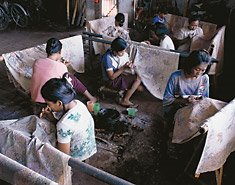
Pekalongan is well known for its home-based fine Batik industry. (pic source here)

Nothing special there yet. But it’s encouraging that Mr. Basyir cited the Human Development Index (HDI) as a major factor in designing his programmes. The head (Bupati) of Jembrana district in Bali is also leading pro-poor programmes based on HDI, and Jembrana’s success is now promoted all over the country. [See a handbook on 'how to be like Jembrana', also read reviews here and here]

Our visit to the second city, Solo (officially known as Surakarta – in the centre of Central Java), is no less encouraging. Mr. Jokowi, who’s left his furniture export business to become Mayor, was with us for almost the whole day, as he took us around the city to show how he dealt with the informal traders ‘issue.’


Solo is often considered the source of 'finer' Javanese culture. They have a wayang puppet-mastering depertment (Jurusan Pedalangan) in STSI - Surakarta Art Institute.

Just 5 days before our visit, 1,000 informal traders conduct business on the public parks around Banjarsari Monument. Now they’ve all moved to a newly built Notoharjo ‘klithikan’ market in an area called Semanggi, which is still located in the business area of the city. The Mayor spent the last 9 months negotiating with traders associations, and came out with a deal like this: each trader would get a lot in the market, and he/she would have it free of rent and taxes for the upcoming 6 months. Each would also receive 5 million rupiahs (~500 USD) of soft loan as business capital. The Mayor expected that the new market will have return of investment in 8-9 years. After traders moved to the new market just 4 days before, we saw that the market is already bustling. Now that the monument is back on public hands, the Mayor is refurbishing the old monument for the upcoming Independence Day celebration in mid August. [read reviews from Kompas and Jawa Pos]

Maybe we should encourage more medical doctors (the Bupati of Jembrana is also one!) and entrepreneurs to be Mayors? :) Or what about Faisal Basri as Governor of Jakarta?

Technorati technorati tags: , , ,

Problems with Low-income Housing Mortgage

Last week we went to three banks, BRI, BTN, and Bukopin, to see the possibility of them providing finance for low-income housing. BRI has heavy emphasis on financing small and micro businesses, BTN on housing/property mortgages, and Bukopin on cooperatives.

Here are several issues discussed:

  1. A bank complained that the government doesn’t have vision on how we should deal comprehensively with the problem of low-income housing needs, while many local governments are only interested in projects from which they can take advantage.
  2. They also said it may be interested in financing such projects if the government provides two things: legal land titles (new, large quantities of subdivided land), with basic infrastructure (the most important being roads, electricity, and water)
  3. Another bank raised the issue of insurance/guarantee funds and control over subletting.
  4. They said they can provide financing for corporation/enterprise’s workers housing, and for ‘solid cooperatives’ (which they need assess first).
  5. Another bank complained about the lack of legal enforcement for those who default. They said that there have been too many cases where if someone is allowed to stop payment, then others will join.


My conclusion so far is that there is a possibility of mobilizing commercial banks to play a role in upgrading and preventing slums. However, the government will need to play an important role in providing the right incentives (not everything can be privatized, of course!). Also, there needs to be better management: both for the community institutions/cooperatives who apply for housing loans, and for the people who manage and maintain such developments.


Technorati technorati tags: , ,

Problems with Supply-driven Low-income Flats

The organization for which I’m currently consulting believes that low-income housing development should be in the private domain. It’s how things are done normally. The government can provide public housings, but to what extent? And what have been the outcomes of such housing built and managed by the government?


Karet Tengsin flats in Central Jakarta. You can see the pointy BNI Tower faintly in the background.


Penjaringan flats in North Jakarta, by the industrial/warehouses. Some have dubbed this a 'vertical slum.'


Let’s look at a couple of low-income flats built and managed by the Jakarta municipality: one in Karet Tengsin, Central Jakarta, and the other in Penjaringan, North Jakarta. In both cases there’s a significant subsidy from the municipality: only one-third of flat costs are to be paid by residents (12 out of 36 million Rupiahs in 10 years – which is dirt cheap). However, a swooping 60% of them have stopped repayment. The rent price still refers to the 1988 Governor’s decree (1,200 to 7,200 Rupiahs – 13 cents to 80 cents – a day!), but residents have constantly protested (demonstrated) every time there’s a plan to increase rents. They also don’t pay utility bills. And worse, the intended target group does not live there anymore; they’ve sublet the flats to those better off, for money of course. And now the flats have somewhat turned into ‘vertical slums.’

Out of frustration, the municipality owned company P.D. Pembangunan Sarana Jaya will return management rights of some of the flats to the municipality (Dinas Perumahan).

Does the main problem lie in management, or in the concept of social housing in the first place? The Jakarta municipality is planning to extend the flats in Karet Tengsin (actually this has recently started) and redevelop those in Penjaringan. For the latter case, costs are estimated between 48 and 64 million USD (depending on the alternative designs). However, the municipality only has 20 million. So how can they effectively serve the increasing housing needs of low-income households inside the city?

Using the approach I mentioned at the beginning, one way to deal with the problem is mobilizing domestic capital (funds from the residents, community groups, and domestic commercial banks) to finance low-income housing development. As has been well documented, the poor actually has money to pay (for example, those living in slums pay more for water than their richer counterparts living in formal areas of the city). Not only that, in many cases the poor are more prudent in repaying loans (for example, see the performance of micro credits).

So why can’t we mobilize these funds (especially banks) to provide financing for such activities? Answer in following post.


Technorati technorati tags: , ,

Monday, July 24, 2006

Endogenous and Genuine Development


It was such a thrill for me to finally see and listen to John Friedmann in person deliver a speech last month. The urban planning guru received the 2006 UN-HABITAT Award and gave the jam-packed inaugural UN-HABITAT lecture at the World Urban Forum in Vancouver. Having read some of his books (Planning in the Public Domain comes first to mind) passionately, and studied at the department that he founded and chaired for 14 years, I was so eager to hear what he has to say for today’s context.

Friedmann’s speech, titled The Wealth of Cities: Towards an assets-based development of urbanizing regions, was the ultimate progressive’s answer as to how cities should (choose to) develop amidst all the pressure “to make themselves into commodities for the capital market” and “to frustrate themselves to the power of global capital.” He said all this is useless as “when capital finds more attractive regions, they will leave the city, leaving abandoned factories…” Friedmann therefore argued for “endogenous, genuine development.”

And how should endogenous growth be done? Friedmann provided 7 clusters of regional assets into which local governments must invest:

  1. Human assets: encompassing those that support a person’s right to live: housing, education, health
  2. Social assets: civil society – or the bonds that tie people together, be it via religion, sport, music, hobby, what have you.
  3. Cultural assets: includes physical heritage such as buildings and places, but also those of “everyday life vibrancy,” including popular traditions and festive occasions.
  4. Intellectual & creative assets: intellectuality and creativity must be nurtured; there has to be “a freedom to create;” “creativity can’t be commanded, but creative work must have public support.”
  5. Natural assets: including forests, rivers, and the urban fringe. The city needs them as they are part of the urban as well (Friedmann’s words were “where does the city end and the countryside begin?”)
  6. Environmental assets: conditions/things that make living in the city bearable physically, such quality of water, air, space.
  7. Urban infrastructure assets: including urban transportation and utilities. The question is whether to invest in infrastructures of the rich minority (the 15% automobile class) or the poor(er) majority (the 80% transit and walking class). [note: I’m not sure to which city Friedmann was referencing these numbers, but you get the point]

After all these years, Friedmann is still the progressive planner. I can totally relate to his current ideas through his old writings. His argument slaps the faces of cities competing with each other to host the Olympics and attract foreign investments. The assets are not "out there" to compete for, but within a city/region all along…


Technorati technorati tags: , , ,